
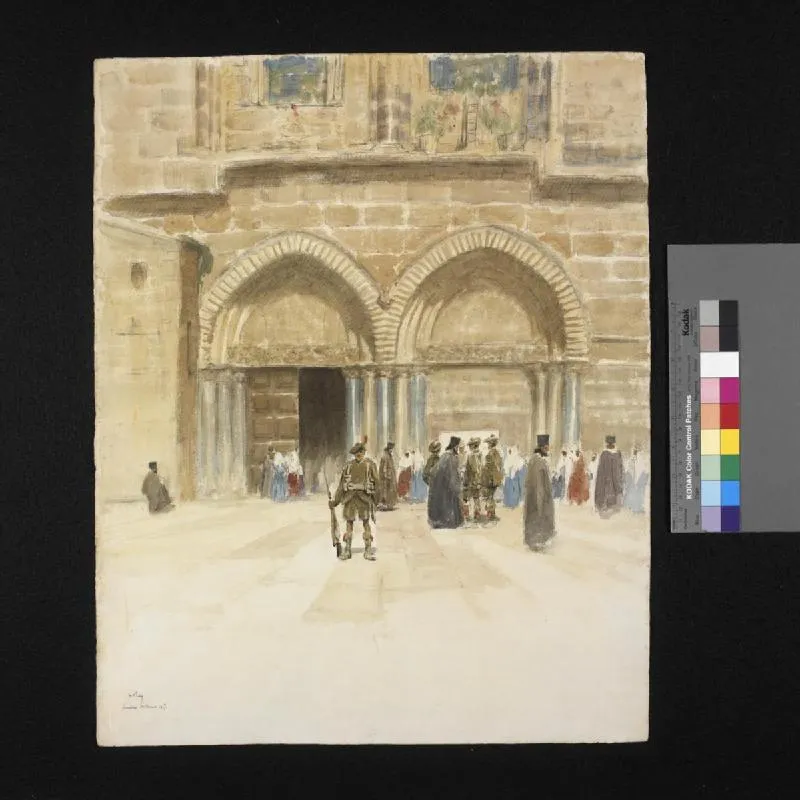
In the bustling temple, Jesus finds himself on the hot seat. The religious leaders demand answers about his authority, but he turns the tables with clever questions and thought-provoking parables.
The Reading: Luke 20
World English Bible1 On one of those days, as he was teaching the people in the temple and preaching the Good News, the priests and scribes came to him with the elders.
>
2 They asked him, “Tell us: by what authority do you do these things? Or who is giving you this authority?”
>
3 He answered them, “I also will ask you one question. Tell me:
>
4 the baptism of John, was it from heaven, or from men?”
>
5 They reasoned with themselves, saying, “If we say, ‘From heaven,’ he will say, ‘Why didn’t you believe him?’
>
6 But if we say, ‘From men,’ all the people will stone us, for they are persuaded that John was a prophet.”
>
7 They answered that they didn’t know where it was from.
>
8 Jesus said to them, “Neither will I tell you by what authority I do these things.”
>
9 He began to tell the people this parable. “A man planted a vineyard, and rented it out to some farmers, and went into another country for a long time.
>
10 At the proper season, he sent a servant to the farmers to collect his share of the fruit of the vineyard. But the farmers beat him, and sent him away empty.
>
11 He sent yet another servant, and they also beat him, and treated him shamefully, and sent him away empty.
>
12 He sent yet a third, and they also wounded him, and threw him out.
>
13 The lord of the vineyard said, ‘What shall I do? I will send my beloved son. It may be that seeing him, they will respect him.’
>
14 “But when the farmers saw him, they reasoned among themselves, saying, ‘This is the heir. Come, let’s kill him, that the inheritance may be ours.’
>
15 They threw him out of the vineyard, and killed him. What therefore will the lord of the vineyard do to them?
>
16 He will come and destroy these farmers, and will give the vineyard to others.” When they heard it, they said, “May it never be!”
>
17 But he looked at them, and said, “Then what is this that is written, ‘The stone which the builders rejected, the same was made the chief cornerstone?’
>
18 Everyone who falls on that stone will be broken to pieces, but it will crush whomever it falls on to dust.”
>
19 The chief priests and the scribes sought to lay hands on him that very hour, but they feared the people—for they knew he had spoken this parable against them.
>
20 They watched him, and sent out spies, who pretended to be righteous, that they might trap him in something he said, so as to deliver him up to the power and authority of the governor.
>
21 They asked him, “Teacher, we know that you say and teach what is right, and aren’t partial to anyone, but truly teach the way of God.
>
22 Is it lawful for us to pay taxes to Caesar, or not?”
>
23 But he perceived their craftiness, and said to them, “Why do you test me?
>
24 Show me a denarius. Whose image and inscription are on it?” They answered, “Caesar’s.”
>
25 He said to them, “Then give to Caesar the things that are Caesar’s, and to God the things that are God’s.”
>
26 They weren’t able to trap him in his words before the people. They marveled at his answer, and were silent.
>
27 Some of the Sadducees came to him, those who deny that there is a resurrection.
>
28 They asked him, “Teacher, Moses wrote to us that if a man’s brother dies having a wife, and he is childless, his brother should take the wife, and raise up children for his brother.
>
29 There were therefore seven brothers. The first took a wife, and died childless.
>
30 The second took her as wife, and he died childless.
>
31 The third took her, and likewise the seven all left no children, and died.
>
32 Afterward the woman also died.
>
33 Therefore in the resurrection whose wife of them will she be? For the seven had her as a wife.”
>
34 Jesus said to them, “The children of this age marry, and are given in marriage.
>
35 But those who are considered worthy to attain to that age and the resurrection from the dead, neither marry, nor are given in marriage.
>
36 For they can’t die any more, for they are like the angels, and are children of God, being children of the resurrection.
>
37 But that the dead are raised, even Moses showed at the bush, when he called the Lord ‘The God of Abraham, the God of Isaac, and the God of Jacob.’
>
38 Now he is not the God of the dead, but of the living, for all are alive to him.”
>
39 Some of the scribes answered, “Teacher, you speak well.”
>
40 They didn’t dare to ask him any more questions.
>
41 He said to them, “Why do they say that the Christ is David’s son?
>
42 David himself says in the book of Psalms, ‘The Lord said to my Lord, “Sit at my right hand,
>
43 until I make your enemies the footstool of your feet.”’
>
44 “David therefore calls him Lord, so how is he his son?”
>
45 In the hearing of all the people, he said to his disciples,
>
46 “Beware of those scribes who like to walk in long robes, and love greetings in the marketplaces, the best seats in the synagogues, and the best places at feasts;
>
47 who devour widows’ houses, and for a pretense make long prayers: these will receive greater condemnation.”
What This Chapter Is Really Saying
The Challenge of Authority
As Jesus teaches in the temple, the priests and scribes confront him, demanding to know by what authority he performs his miracles and teaches. Instead of answering directly, Jesus poses a question about John the Baptist's baptism - was it from God or men? The leaders are caught in a dilemma: if they admit John's authority, they would have to justify why they didn't believe him, but if they dismiss him, they risk the wrath of the people who see John as a prophet. Ultimately, they claim ignorance, and Jesus declines to reveal his authority.
The Parable of the Wicked Farmers
Next, Jesus shares a gripping parable about a vineyard owner who sends servants to collect his share of the harvest. However, the farmers mistreat each servant, culminating in the murder of the owner's beloved son. The farmers think they can seize the inheritance for themselves, but Jesus warns that the owner will come and destroy them, handing the vineyard to others. This parable draws a direct line to the religious leaders, who realize it speaks against them.
Questions About Taxes and Resurrection
The scene shifts as spies sent by the leaders attempt to trap Jesus with a question about paying taxes to Caesar. Cleverly, Jesus asks for a coin and points out that it bears Caesar's image. He concludes with the famous line to give to Caesar what belongs to him, while also emphasizing the importance of giving to God what belongs to Him.
Next, the Sadducees enter with a convoluted question about resurrection - if a woman marries seven brothers (one after another) and they all die, whose wife will she be in the resurrection? Jesus clarifies that life after resurrection is not like life on earth; those resurrected will be like angels, not tied to marriage.
The Identity of the Christ
Finally, Jesus poses a question about the identity of the Messiah, referencing David's words. If David calls the Messiah 'Lord,' how can he also be his son? This confounds the religious leaders, who are left speechless. He concludes with a warning about the scribes who exploit the vulnerable, assuring their condemnation.
Why It Matters
Reflection on Authority
This chapter teaches us about the nature of authority. Just like the religious leaders, we often grapple with questions of power and authenticity. Jesus invites us to recognize that true authority comes from God and aligns with His purposes.
The Importance of Integrity
Jesus' parable reminds us of the consequences of selfishness and greed. The farmers in the vineyard failed to honor their commitments and faced dire consequences. It calls us to be responsible stewards of what we have been given, recognizing that our actions impact others.
Embracing Resurrection
The discussion about resurrection sheds light on the hope of life beyond this world. Jesus emphasizes that in God's eyes, all are alive. This should encourage us to live with purpose, understanding that our earthly ties are temporary, but our relationship with God is eternal.
If you find yourself seeking a deeper understanding of these teachings and want to connect with others on a similar journey, consider find a church near you. Churches can provide community and support as we explore these profound truths together.
![The Parable of the Laborers in the Vineyard. 1637. Oil on panel. The Hermitage, St. Petersburg, Russia. [1]](https://firebasestorage.googleapis.com/v0/b/sancta-91eb1.firebasestorage.app/o/blog-images%2Fscripture%2F6848572.webp?alt=media&token=a695ac50-45f7-4088-8512-798d49482dab)
Coming Up Next: Luke 21
In the next part of our journey through Luke, we will delve into chapter 21, where Jesus discusses the end times, the widow's offering, and the signs of the coming days. Join us for more insights!